Oil Painting: Basics and Beyond with Fran Failla
Saturday, October 10
10am – 2pm
Price:
$80
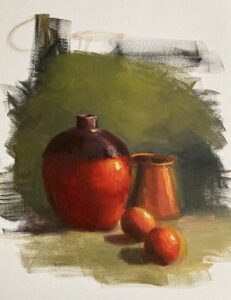
In this four-hour class, students will receive a “crash course” in oil painting. This course is perfect for those who are just beginning and those looking to expand on their skills.
We will work with a simple color palette, going over the properties of oil paints, and also discuss which brushes and canvases are best to use, touching on the pros and cons of each.
Students will learn how easy it is to paint in this medium through teacher demonstration and experimentation. Each student will create a work of art that they can take home the same day.
Note:
Students should bring smocks or wear old clothes.
Materials list:
Located at the bottom of the page
Class will be held at: Morean Arts Center, 719 Central Ave., St. Petersburg, FL 33701
Artist Bio:
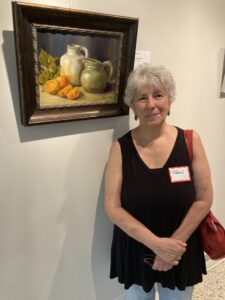
I began painting in oils when I was in my early teens and have been painting for over 50 years. I studied for many years at the Art Students Leage in New York City and am trained in classical oil painting. My specialty is still life.
I moved to the Tampa Bay area in 2018 and have continued to study, paint, and teach oil since that time. I have been awarded the Creative Pinellas Emerging Artist Grant in 2024, and the Halo Arts Project Fellowship Award in 2025.

Suggested Materials List
Paints:
Note: Several types of oil paints exist on the market. The most expensive (but the best quality) are the
“professional” grade paints, such as Michael Harding and Sennelier brands. You can choose less
expensive brands such as Winton oils, which is a lower quality product known as “student” grade, for
this workshop.
–Flake White or Flake White Hue (the non-toxic kind)
–Ivory Black
–Ultra Marine Blue
–Cadmium Red or Cadmium Red Light
–Cadmium Yellow or Cadmium Yellow Pale
–Orange or Cadmium Yellow Deep
–Yellow Ochre or Yellow Ochre Light
–Naples Yellow
–Burnt Umber or Raw Umber
–Dioxizine Purple
Brushes:
Note: Try to choose “Long handle” brushes made for oil paints. (Good inexpensive brushes can be
found at Michael’s or Hobby Lobby.)
–Flats – #12 “sable” or artificial sable
–Filberts – #8 and #10 sable
–1 standard palette knife
Palette:
–Use paper (grey sheets) or plastic. Don’t use wooden palettes.
Mediums:
–Refined Linseed Oil or Cold Pressed Linseed
*Do not bring any turpenoid/turpentine products or highly odorous products
Canvas:
–Canvas can be either stretched or panels, in cotton or linen. (cotton is less expensive). Your canvas
should be no smaller than 8” x 10”. Ideally, use either 9” x 12” or 11” x 14”.
Additional Materials:
–You MUST bring paper towels and clean cotton rags. Also bring quart sized plastic bags. (Note that all
used brushes will be cleaned with linseed oil and rags only.)
Note: that all oil paint materials and demonstration paintings will be taken home the same day. Full
clean-up will be done at home at the end of the workshop.
Easels are available for use or, if the student chooses to work at a table, bring a table easel.